Thursday, December 4, 2014

Starry Starry Night


Yesterday during our mid-week Evening Prayer we sang the hymn, Creator of the Stars at Night. It isn't quite as familiar as some others. And it never is a requested hymn -- at least in my experience. Yet it remains a treasure. It is a hymn that has been dated to the 9th century. So, for well over half of the Church's existence, this song has been sung. 

Perhaps even more profound than it's plainsong setting are the words. They have been variously translated from the original Latin and arranged accordingly, yet they get to the heart of the matter.

Take a moment to meditate on the following text of this hymn as included in our Evangelical Lutheran Worship.

Creator of the stars of night,
Your people’s everlasting light, 
Oh Christ, Redeemer of us all, 
We pray you hear us when we call. 

When this old world drew on toward night 
You came, but not in splendor bright 
Not as a monarch but the child 
Of Mary, blameless, mother mild.

At your great name, oh Jesus, now 
All knees must bend all hearts must bow 
All things on Earth with one accord 
Like those in Heaven, shall call you Lord. 


Come in your holy might, we pray,
redeem us for eternal day;
defend us while we dwell below
from all assaults of our dread foe.


To God the Father, God the Son, 
And God the Spirit, Three in One, 
Praise, honor, might, and glory be 
From age to age eternally.

Amen

The Trinity with Chalice (1914) Eric Gill

This coming Sunday is the Second Sunday of Advent. If you have not yet taken the opportunity to intentionally enter into this season of preparation and spiritual house-cleaning, there is still time. John the Baptizer appears on the horizon at the beginning of the gospel of Mark. His presence is a always a reminder of repentance and being prepared. He calls out to us: 
"The one who is more powerful than I is coming after me;
I am not worthy to stoop down and untie the thong of his sandals.
I have baptized you with water;
but he will baptize you with the Holy Spirit."   (Mark 1:7-8) 
Are we prepared? Are we ready to be baptized with the Holy Spirit? Are we willing to be fully immersed, covered over, and transformed by the Holy Spirit? What would such surrender and acceptance mean for you and for me? How might it empower and reconfigure our priorities and ability to live into the will of God? How might our cares, anxieties, and fears be relieved by such an encounter?

The next time we have a clear night sky at our disposal, take a walk. Or, at least go out on the porch and look up. Consider, along with the psalmist, the heavens, the work of God's fingers, the moon and the stars that have been set in their courses.  (cf. Psalm 8).

O LORD, our Lord, how majestic is your name in all the earth!  (Psalm 8:9)

The Ghent Altarpiece - St. John the Baptist (detail)
between 1425 and 1429
Jan van Eyck

Thursday, November 20, 2014

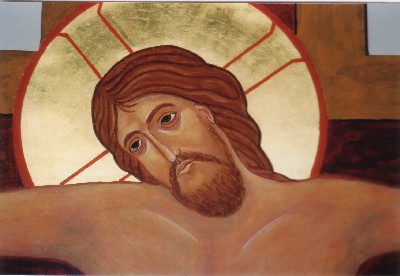
Christus Rex


This week I invite you to consider the pictures here and see what sort of connections you can discover. These are images of recognizable people (at least I'm assuming).  How many different relationships and connections can you recognize? What are their names, titles and roles? Does any of this matter?


Christ the King on cross detail.JPG

In our day and age, when we hear a claim that Christ is King, what are we hearing? In the day and age of the first century, what sort of impact do you think the assertion that  Christ is Lord had?

Nearly ninety years ago the festival of that we observe and celebrate this coming Sunday had its official beginning. Pope Pius XI established this feast in an encyclical Quas Primas Here is a paragraph from Quas Primas to consider.  (Keep in mind that gender-inclusive language was not much of a concern in 1925).
“If to Christ our Lord is given all power in heaven and on earth; if all men, purchased by his precious blood, are by a new right subjected to his dominion; if this power embraces all men, it must be clear that not one of our faculties is exempt from his empire. He must reign in our minds, which should assent with perfect submission and firm belief to revealed truths and to the doctrines of Christ. He must reign in our wills, which should obey the laws and precepts of God. He must reign in our hearts, which should spurn natural desires and love God above all things, and cleave to him alone. 
He must reign in our bodies and in our members, which should serve as instruments for the interior sanctification of our souls, or to use the words of the Apostle Paul, as instruments of justice unto God” (Romans 6:13).   
Pope Pius XI, Quas Primas, 33  -  December 11, 1925
The festival of Christ the King is the last Sunday of the Church Year.  The following Sunday we begin again with the first Sunday of the new church year, or the First Sunday of Advent. So, this Sunday is in a real sense pivotal. In a deeper way it points us to a core claim of our life as children of God in Christ. We are summoned to clarify our allegiances.  Yikes!  This sounds like such a task and hard work.

Maybe one of the most straightforward ways of doing this hard work is simply to get to it. Postponing, in this case, is just another form of procrastinating.

Let me share an example. My son Gabriel will likely never win an award for the tidiest bedroom. Periodically, however, a thorough housecleaning is in order. At first glance the task seems overwhelming if not entirely futile. And the longer it is postponed . . . well, let's not go there! 
Last evening, we made a start. Gabriel and I worked together to clean his room (mostly he talked to me while I cleaned his room!). We didn't finish the task yet, but we did make good headway. 

The point is, not everything in the room can claim Gabriel's allegiance. One need only take the time to look around and it is obvious that some things are more important than others. And so, the tedious and difficult work of picking through everything has to commence. Taking inventory like this is the only way to do it. Some things need to be thrown away as the trash that they are, while other things are rediscovered as the valued and meaningful possessions that they are. But it takes work and being intentional.

How can we apply this to our spiritual lives?  Is our room a mess? Are we do for a thorough housecleaning?  

Christ the King Sunday and the anticipation of a new year is a great time to get down on our knees and take stock of the people, plans, and possessions with which we surround ourselves. What can be said of our ultimate allegiance? Is Christ King in our hearts? Are we in need of another revolution?

Thursday, November 6, 2014

Where there is despair,

The Scream, Edvard Munch, 1893
In [Christ] we were also chosen, destined in accord with the purpose of the One who accomplishes all things according to the intention of his will, so that we might exist for the praise of his gory, we who first hoped in Christ.  Ephesians 1:11-12
These verses from Ephesians were part of my morning devotions today. Paul seems so confident and assured -- as if it should be self-evident that God is large and in-charge. However, sometimes God feels distant, uninterested, and at best oblivious to the daily trials and burdens with which we so valiantly contend.

We confess that, in Christ, God has come near. The faith of the church is that God has taken on our nature and our lot and has made us a new creation in Christ. While that is the official "company" line, for many it seems to be simply too many words. When we walk through the valley of the shadow of death, or when we find ourselves bombarded with so many trials and perplexities, it would be nice for a clearer -- more obvious -- way that leads to life.

When we lack the clarity and confidence that we believe must materialize following our hard work and fidelity to expectations, than it is so easy to despair.

So what do we say to one another when we are in such a situation?  How do we assist one another to weather such periods of confusion and indifference?

These are some of the questions I ponder as your pastor.

My current conclusion is that we (and when I say we, I am referring to "us" as a congregation) have both an opportunity and an obligation to be a community in which it is okay to question, doubt, and be open and honest about our struggles. In other words, we ought not feel obligated to "put on a happy face" when inside, in our gut, we are struggling and suffering. If the church, the community of faith, isn't a place in which we can be honest and authentic, then what are we to do?

What do you think?  What can we do for and with one another when we are faced with difficulties that test our faith beyond our individual ability to contend? How do you keep things in perspective? What experiences have you had that seemed to threaten your spiritual vitality? How could you share your faith and strength with others who are need of your witness?

Jesus Prays in Gethsemane

Trouble and perplexity drive me to prayer and prayer drives away perplexity and trouble.                                          - Philipp Melanchthon

+            +            +

Twenty-second Sunday after Pentecost
November 9, 2014

Prayer of the Day
O God of justice and love, 
you illumine our way through life with the words of your Son. 
Give us the light we need, 
and awaken us to the needs of others, 
through Jesus Christ, our Savior and Lord.

Readings
Amos 5:18-24
Psalm 70
1 Thessalonians 4:13-18
Matthew 25:1-13


Thursday, October 23, 2014

Reformation and Creed

So far in the history of the Church, it seems that every 500 years or so, there is some sort of course correction or major shift and change:
  • The period from 325 to 787 witnessed the Seven Ecumenical Councils
  • The East-West Schism (or so-called "Great Schism") of 1054
  • The Reformation, 1517 - 1529
Are we currently in the midst of another such period of transformation? 

This Sunday the church observes the Festival of the Reformation. We'll remember the Reformation of the 16th Century. And we'll also discuss the Reformation of the 21st Century. And, believe it or not, this all fits in well with our ongoing consideration of Martin Luther's Small Catechism.

Below is an image of what is known as Luther's Rose or the Luther Seal. Following it is Martin Luther's own explanation of its meaning. If you were to compose an image that would represent your faith or the Faith of the Church, what would it look like?


Explanation of Luther's Rose
Grace and peace from the Lord. As you desire to know whether my painted seal, which you sent to me, has hit the mark, I shall answer most amiably and tell you my original thoughts and reason about why my seal is a symbol of my theology. 
The first should be a black cross in a heart, which retains its natural color, so that I myself would be reminded that faith in the Crucified saves us. For one who believes from the heart will be justified" (Rom. 10:10). 
Although it is indeed a black cross, which mortifies and which should also cause pain, it leaves the heart in its natural color. It does not corrupt nature, that is, it does not kill but keeps alive. "The just shall live by faith" (Rom. 1:17) but by faith in the crucified. 
Such a heart should stand in the middle of a white rose, to show that faith gives joy, comfort, and peace. In other words, it places the believer into a white, joyous rose, for this faith does not give peace and joy like the world gives (John 14:27). That is why the rose should be white and not red, for white is the color of the spirits and the angels (cf. Matthew 28:3; John 20:12). 
Such a rose should stand in a sky-blue field, symbolizing that such joy in spirit and faith is a beginning of the heavenly future joy, which begins already, but is grasped in hope, not yet revealed. 
And around this field is a golden ring, symbolizing that such blessedness in Heaven lasts forever and has no end. Such blessedness is exquisite, beyond all joy and goods, just as gold is the most valuable, most precious and best metal. 
This is my compendium theologiae [summary of theology]. I have wanted to show it to you in good friendship, hoping for your appreciation. 
May Christ, our beloved Lord, be with your spirit until the life hereafter. Amen. 
Martin Luther   
Letter to Lazarus Spengler, July 8, 1530.

+            +            +

Reformation Sunday
October 26, 2014

Prayer of the Day
Almighty God, gracious Lord, 
we thank you that your Holy Spirit renews the church in every age. 
Pour out your Holy Spirit on your faithful people. 
Keep them steadfast in your word, 
protect and comfort them in times of trial, 
defend them against all enemies of the gospel, 
and bestow on the church your saving peace, 
through Jesus Christ, our Savior and Lord, 
who lives and reigns with you and the Holy Spirit, 
one God, now and forever. Amen

Readings
Jeremiah 31:31-34
Psalm 46
Romans 3:19-28
John 8:31-36

Thursday, October 16, 2014

. . . and our neighbors . . .

Early Sunday Morning
Edward Hopper, 1930

It should come as no surprise to you that at the rate we are going, there is no way that we are going to "get through" Luther's Small Catechism in the two weeks remaining in our current study. The time allotted has been sufficient for a mere introduction. But to both be comprehensive and thorough requires more than four consecutive 50-minute sessions. This is not a lament. It's just an observation. It is fine to move deeper rather than spread ourselves too thinly.

The good news is that by now everyone should have access to a copy of the Small Catechism, whether you obtained your own or are using the one included in the ELW (Evangelical Lutheran Worship). The important thing is to read it.


In a general way, we will look at the remaining commandments in the top ten list this Sunday. As I suggested at the end of last week's class, these remaining commandments address the horizontal dimension of our faith. While the first several deal primarily with our relationship with and understanding of God, the rest are concerned with our relationship with and understanding of one another.  Again, notice how in his explanations to each of the commandments Luther describes not only what the commandments forbid, but also what is prescribed and encouraged.

+            +            +


In worship on Sunday (October 19, 2014) we will be observing the Festival of St. Luke. Actually, Saturday, October 18th is the commemoration of St. Luke. But since we are the congregation of St. Luke, we are transferring the celebration and observance to Sunday. The festival of St. Luke is an opportune time for the church to emphasize its calling to engage in healing ministry. Therefore, there will be an opportunity for the laying on of hands and anointing with oil and healing prayer during worship on Sunday. Please share an invitation with friends, neighbors, and family about this ministry. All are welcome and guests are expected.


PRAYER OF THE DAY

Almighty God, you inspired your servant Luke 
to reveal in his gospel the love and healing power of your Son. 
Give your church the same love and power to heal, 
and to proclaim your salvation among the nations 
to the glory of your name, through Jesus Christ, your Son, our healer, 
who lives and reigns with you and the Holy Spirit, one God, now and forever. Amen


READINGS

Isaiah 43:8-13
Psalm 124
2 Timothy 4:5-11
Luke 1:1-4; 24:44-53

Thursday, October 9, 2014

The Big Ten

Moses with the Ten Commandments 
byRembrandt (1659)

We continue our exploration of Martin Luther's Small Catechism this Sunday. Written in 1529, Luther's explanations to the chief parts of the Christian faith are still timely and can serve to provide us with a framework and reference for our discussion. We'll dwell in Luther's treatment of the Ten Commandments.

As I was preparing for class this week, I referenced a book by Timothy J. Wengert entitled Martin Luther's Catechisms: Forming the Faith. Certainly faith formation is essential to our continued growth in grace and the maturing of our discipleship. Wengert notes that already in 1522 Martin Luther produced his Betbüchlein (Personal Prayer Book).  Here is an excerpt from Luther's forward:
Three things people must know in order to be saved. First, they must  know what to do and what to leave undone. Second, when they realize that they cannot measure us to what they should do or leave undone, they need to know where to go to find the strength they require. Third, they must know how to seek and obtain their strength. It is just like a sick person who first has to determine the nature of that sickness, then find out what to do or to leave undone, After that he has to know where to get the medicine which will help him do or leave undine what is right for a healthy person. Third, he has to desire to search for this medicine and to obtain it or have it brought to him. Thus, the commandments teach human beings to recognize their sickness.  . . . The Creed will teach and show them where to find the medicine--grace--which will help them become devout and keep the commandments. The Creed points them to God and his mercy, given and made plain in to them in Christ. Finally, the Lord's Prayer teaches all this namely, through the fulfillment of God's commandments [by faith] everything will be given them. (LW 43:13-14, with slight changes)
In the days ahead, take some time to read the both Exodus 20:2-17 and Deuteronomy 5:6-21. What do you see there?  What is similar? What is different? What don't you see there?

The second part of the All Souls Deuteronomy, containing the Decalogue

+            +            +

Eighteenth Sunday after Pentecost
October 12, 2014

Prayer of the Day
Lord of the feast, you have prepared a table before all peoples 
and poured out your life with abundance. 
Call us again to your banquet. 
Strengthen us by what is honorable, just, and pure, 
and transform us into a people of righteousness and peace, 
through Jesus Christ, our Savior and Lord. Amen

Readings
Isaiah 25:1-9
Psalm 23
Philippians 4:1-9
Matthew 22:1-14


Wednesday, October 1, 2014

Basics


On Sunday at our weekly Faith Formation Forum we will begin an exploration of Martin Luther's Small Catechism. When I went through confirmation classes, Luther's Small Catechism served as our textbook for our instruction. Along with the Bible, the Small Catechism outlined the basics in the Christian faith and served as a guide in our preparation for Affirmation of Baptism. . . at least, that was the intention.

What has been your experience with the Small Catechism in the past? (If you have none, don't worry. That doesn't disqualify you. In fact, it's all the more reason why you will benefit from this series!)

In preparation for the class, I invite you to read and meditate on two passages from the New Testament.  The first is the passage we often refer to as the Great Commission (Matthew 28:16-20). Here it is:
Now the eleven disciples went to Galilee, to the mountain to which Jesus had directed them. When they saw him, they worshiped him; but some doubted. And Jesus came and said to them, “All authority in heaven and on earth has been given to me. Go therefore and make disciples of all nations, baptizing them in the name of the Father and of the Son and of the Holy Spirit, and teaching them to obey everything that I have commanded you. And remember, I am with you always, to the end of the age."
Matthew 28:16-20 New Revised Standard Version (NRSV)

The second passage, a bit shorter, is from Paul's letter to the church at Galatia:
Those who are taught the word must share in all good things with their teacher.
Galatians 6:6 New Revised Standard Version (NRSV)

I'm looking forward to this series of classes. You are invited to gather with us at 8:45 AM on Sunday as we make a start. Everyone is welcome: prospective members, experienced members, church council members, curious inquirers, friends, guests, neighbors . . . etc.  Take a moment to invite someone to come along with you.  If we run out of room in the fellowship hall, we an always move to the nave of the church!


To believe that Christ was crucified for us, that He died and was damned for us, requires the power of God. Thus St. Paul says to the Corinthians: "We preach Christ crucified, a stumbling block to Jews and folly to Gentiles" (1 Cor. 1:23). And yet this proclamation penetrates the heart; for "it is the power of God for salvation to everyone who has faith"
Martin Luther, Sermon on John 3:14
+            +            +

Seventeenth Sunday after Pentecost
October 5, 2014

Prayer of the Day
Beloved God, from you come all things that are good. 
Lead us by the inspiration of your Spirit 
to know those things that are right, 
and by your merciful guidance, help is to do them, 
through Jesus Christ, our Savior and Lord.  Amen

Readings
Isaiah 5:1-7
Psalm 80:7-15
Philippians 3:4b-14
Matthew 21:33-46